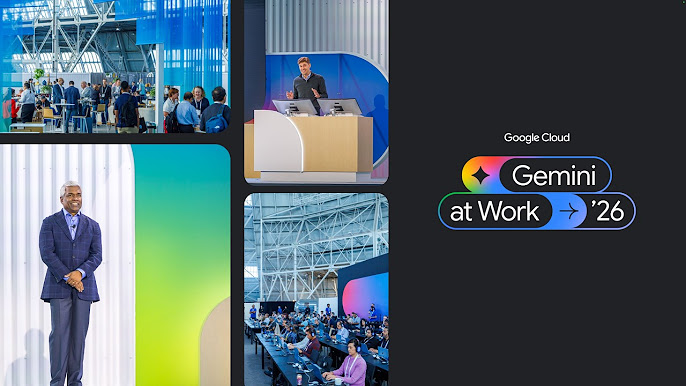

Google is advancing the role of artificial intelligence in the workplace with a universal Gemini AI agent designed to help professionals manage multiple tasks from a single workspace. Announced at Google Cloud’s Gemini at Work event, the concept brings together knowledge work, content creation, question answering, and code generation through one prompt interface. By combining business context, integrations, and specialized AI agents, Google aims to move AI beyond simple conversations toward a more comprehensive digital coworker.
The development reflects a broader shift in workplace technology. Instead of requiring employees to switch between separate tools for research, writing, analysis, and programming, an AI agent could help coordinate different activities within a connected workflow. If implemented effectively, this approach could reduce repetitive work, simplify collaboration, and help businesses make better use of their existing information.
What Is Google’s Universal Gemini AI Agent?
Google’s universal Gemini AI agent is designed to function as an all in one AI coworker that supports a variety of professional responsibilities. Rather than limiting users to a traditional chatbot experience, the concept combines multiple capabilities through a central prompt box.
Employees could ask questions, organize information, draft business content, complete knowledge based tasks, or generate code without necessarily moving between different AI interfaces. This consolidated experience could make AI more accessible to employees who need assistance across several departments and job functions.
For example, a marketing professional might use an AI agent to research a campaign, summarize findings, develop content ideas, and generate a basic website component. A business analyst could use similar capabilities to organize information, identify patterns, and prepare a report. The precise tasks available would depend on the product’s implementation, integrations, and permissions.
Why Is Google Developing This Technology?
The growing interest in AI agents comes from businesses seeking faster answers to individual questions. Organizations increasingly want AI systems that can assist with complete workflows, coordinate activities, and use relevant business information to produce useful results.
Traditional chatbots generally respond to individual prompts, leaving users responsible for connecting the results across applications and completing subsequent steps. An AI agent could potentially reduce this manual coordination by handling connected tasks and assigning specific responsibilities to specialized agents.
For Google, this direction also supports the broader development of AI powered productivity tools within the workplace. Businesses already rely on digital platforms for communication, documents, data, and project management. Connecting AI capabilities to these environments could make assistance more relevant to everyday business needs.
How Does the Gemini AI Agent Work?
The proposed experience brings several important capabilities together in one environment.
One Prompt Box for Multiple Tasks
A central interface allows users to describe what they need in natural language. Instead of opening separate tools for writing, research, and coding, employees could request different types of assistance through one entry point. This could simplify the user experience and reduce the time spent switching between applications.
Access Across Devices and Applications
The concept emphasizes access across devices and connections with third party applications. These integrations could allow AI assistance to fit into existing workflows rather than requiring employees to work exclusively inside a single interface. Actual availability would depend on supported applications, account permissions, and product rollout.
Persistent Context and Personalization
Persistent context could help an AI agent retain relevant information and preferences across sessions. This may reduce the need for users to repeatedly explain their goals, writing preferences, or ongoing projects. However, the information retained and the controls available to users would depend on Google’s specific implementation and privacy settings.
Specialized AI Agents Working Together
Another important capability is multi agent collaboration. A primary agent could coordinate specialized sub agents to complete different parts of a complex task. For example, one agent might organize research, another could prepare a draft, and a third could assist with code. Coordinating these activities could help users manage workflows that involve multiple stages.
Business Context and Flexible Models
Access to relevant business data, work history, and connected tools could make responses more specific to organizational needs. The described approach also emphasizes coordinating different AI models to balance output quality, performance, and cost. For companies, these capabilities could make AI assistance more adaptable to different tasks and operational requirements.
Who Could Benefit From a Universal AI Coworker?
The technology could benefit professionals across marketing, operations, software development, research, customer support, and management.
Marketing teams, for instance, could potentially use AI to support research, campaign planning, and content production. Developers could receive assistance with coding tasks, while managers could use AI to organize information and prepare summaries. These are potential applications rather than guarantees of fully autonomous execution.
What Challenges Should Businesses Consider?
Despite its potential, a universal AI agent does not eliminate the need for human judgment. AI generated information can contain errors, and complex tasks may require verification before their results are used in important decisions.
Businesses must also consider data privacy, access permissions, security, integration reliability, and the cost of running AI systems. Persistent context and connections to company information require appropriate governance to ensure sensitive data is handled responsibly. Employees should understand which tasks AI can perform reliably and when human review remains necessary.
The Future of AI in the Workplace
Google’s universal Gemini AI agent represents a vision of AI as a connected workplace assistant rather than an isolated chatbot.
Its practical impact will depend on real world availability, the quality of its integrations, and how effectively businesses manage accuracy, security, and employee adoption. Nevertheless, the direction is clear: workplace AI is increasingly focused on helping people coordinate tasks and workflows, not simply generate answers.
For more insights into artificial intelligence, emerging AI tools, and practical innovations transforming the digital world, follow @aicuratehub on Instagram and visit aicuratehub.com to stay updated on the latest AI developments.