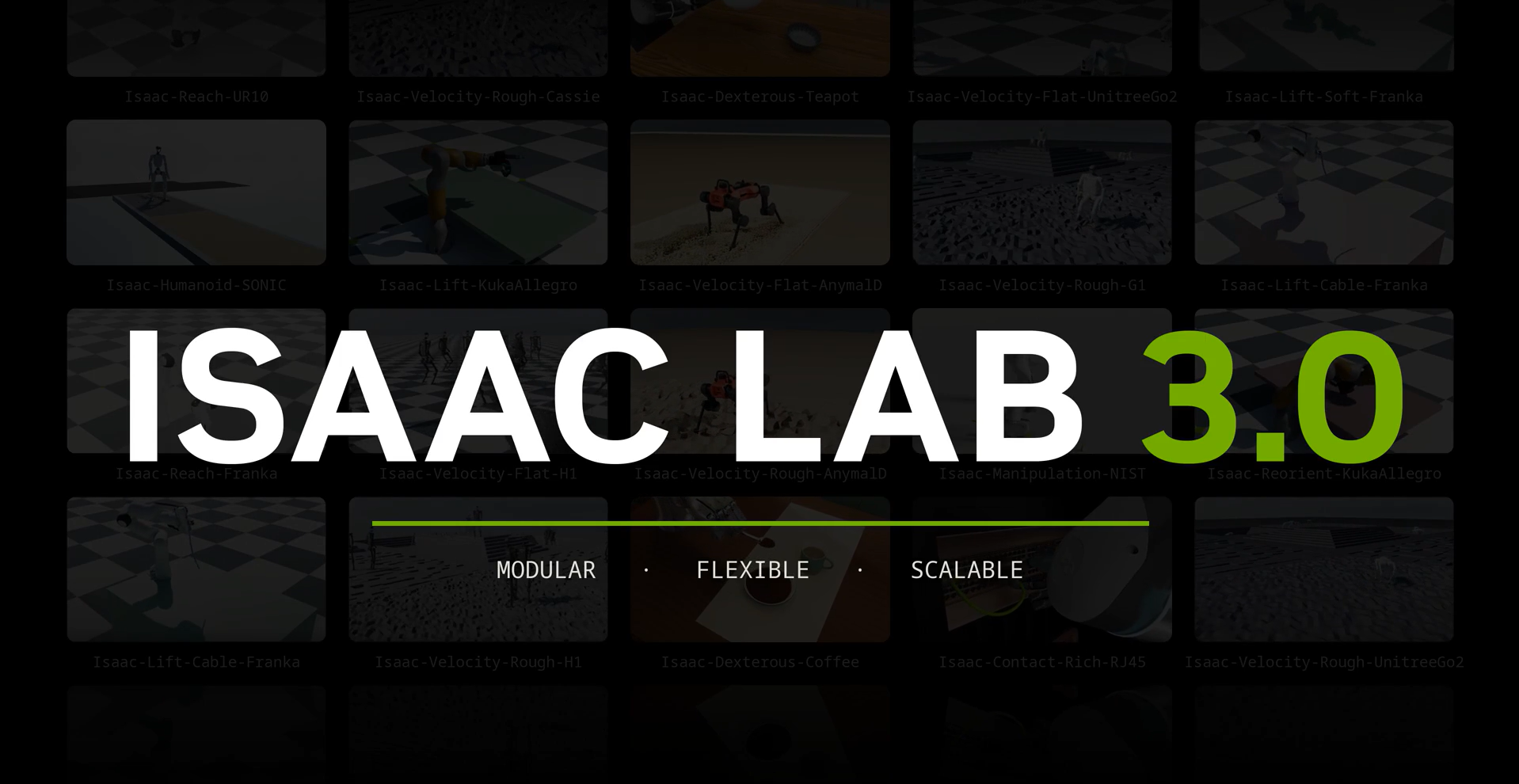

NVIDIA officially unveiled Isaac Lab 3.0, upgrading its premier simulation framework designed for training physical artificial intelligence.
The framework provides developers with a powerful environment to train complex robotic skills efficiently using parallel GPU computation.
Engineers can test autonomous behaviors inside high-fidelity digital environments before deploying software policies directly onto physical hardware.
This major update accelerates the transition of artificial intelligence models from virtual testing spaces into physical real-world environments.
Introducing a Modular Lightweight Simulation Architecture
Isaac Lab 3.0 features a completely redesigned modular architecture engineered to streamline development workflows and reduce system overhead.
Developers can now run lightweight simulations without requiring full software installation packages for every routine testing task.
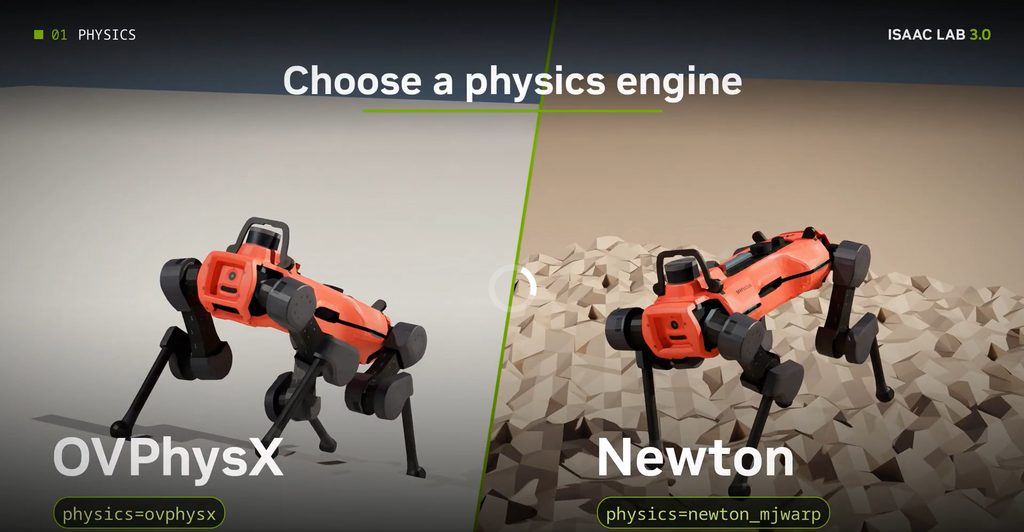
The platform decouples core simulation task logic from specific underlying physics engines and visual rendering pipelines.
This modular design flexibility enables robotics researchers to scale training across multi-GPU computing clusters seamlessly.
Multi-Physics Integration via Newton Engine
The upgrade incorporates Newton, a specialized physics engine integration designed for diverse physical interactions and materials.
Newton supports rigid bodies, soft materials, and particle simulations without locking tasks to a single backend.
Robotics models can practice manipulating flexible cables, deforming soft objects, and grasping rigid industrial tools within identical scenes.
Expanding physics solver options enables robots to learn complex real-world physical dynamics with unprecedented accuracy.
High-Fidelity Rendering Powered by OVTRTX
Visual perception processing receives a massive upgrade through the integration of the OVTRTX renderer library.
The rendering pipeline generates photorealistic lighting, reflections, and sensor inputs for visual imitation learning workflows.
Simulated camera sensors capture lifelike environmental imagery that closely mirrors what physical cameras capture in actual factories.
High visual accuracy prevents neural networks from failing when transitioning from simulated environments into real-world lighting conditions.
Streamlining Reinforcement Learning Post-Training
Isaac Lab 3.0 enhances reinforcement learning post-training tools, enabling fine-tuning for Vision-Language-Action foundation models.
Researchers can train policies across popular frameworks, including RSL-RL, Stable-Baselines3, TorchRL, and skrl backends.
Automated domain randomization applies varying friction, lighting, and mass parameters across thousands of concurrent simulation environments.
Exposing models to diverse virtual conditions builds robust AI control policies capable of adapting to unexpected physical obstacles.
Accelerating Sim-to-Real Transfer with LEAPP Deployment
Bridging the gap between digital simulation and physical hardware deployment remains a major challenge in modern robotics.
Isaac Lab 3.0 solves this bottleneck through seamless integration with the LEAPP policy export framework.
Trained neural network policies export cleanly from cloud training environments directly onto physical edge computing hardware.
Robots can immediately execute complex manipulation behaviors without requiring manual coding or laborious real-world tuning sessions.
Scaling Humanoid and Industrial Robot Development
The platform includes pre-configured environment presets for various hardware designs, including humanoids, quadrupeds, and robotic arms.
Popular robotic platforms like Unitree humanoids, Boston Dynamics Spot, and Franka arms come ready for instant training.
Developers can easily import custom CAD blueprints to build specialized training environments tailored to unique industrial facilities.
Standardizing robot learning workflows accelerates development timelines across manufacturing, logistics, and household service industries.
Transforming Industrial Automation and Smart Manufacturing
Upgrading digital twin simulation frameworks fundamentally changes how industrial companies design and deploy automated machinery.
Factories can train robotic workers inside virtual facilities before physical factory construction or retooling is completed.
Simulating complex manufacturing processes reduces equipment downtime, lowers prototype development costs, and improves operational safety.
Autonomous machines will soon enter real-world assembly lines fully trained to collaborate alongside human workers effectively.
The Future of AI-Powered Robotics Engineering
NVIDIA Isaac Lab 3.0 establishes a new benchmark for open-source GPU-accelerated robot learning frameworks worldwide.
Combining multi-backend physics, advanced rendering, and direct sim-to-real pipelines drastically shortens hardware innovation cycles.
As simulation tools become faster and more realistic, physical robots will learn complex skills in hours instead of months.
This technological leap brings humanity closer to realizing fully flexible, intelligent autonomous systems across daily life.
Follow AI Curate Hub for the Latest Tech News
Staying informed on hardware advancements, simulation engines, and robotics policy is essential for modern technology leaders.
Navigating rapid industrial shifts requires access to reliable news analysis, technical breakdowns, and expert industry perspectives.
Follow @AICurateHub across social media platforms for timely updates, visual content summaries, and software deep dives.
Visit aicuratehub.com today to explore curated insights on artificial intelligence, autonomous robotics, and modern engineering tools.